
C16 vs C24 Timber: Which Strength Grade Do You Need? UK Guide
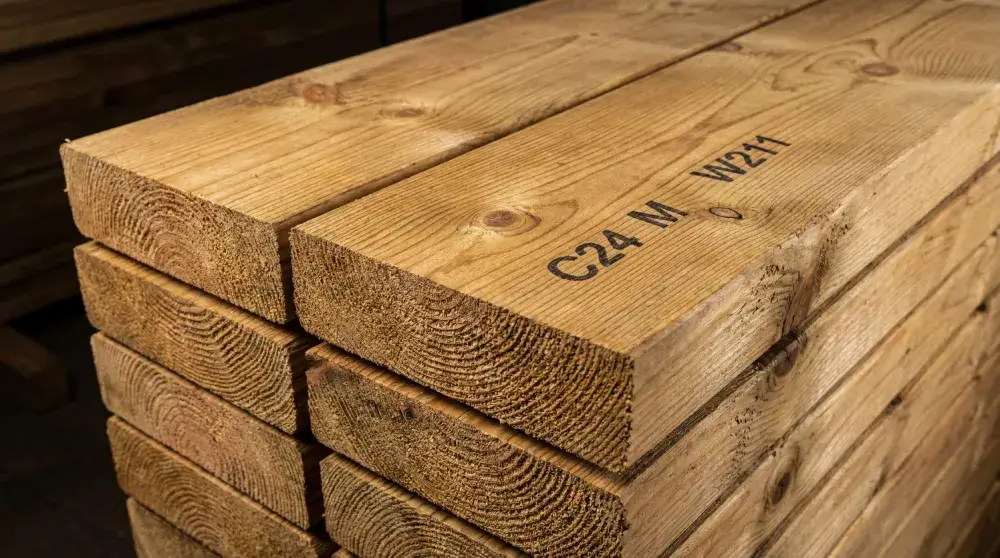
One of the most common questions when buying structural timber is: “Do I need C16 or C24?” The answer depends on your specific application—spans, loads, and Building Regulations requirements—but choosing the wrong grade can lead to structural failures, Building Control rejections, or unnecessary overspending.
This guide explains what C16 and C24 strength classes mean, compares their structural properties, shows you when each grade is required, and helps you make the right specification decision for joists, rafters, studs, and other load-bearing timber.
What Are C16 and C24 Strength Classes?
C16 and C24 are strength classes for structural softwood defined in British and European standard BS EN 338:2016. The “C” stands for coniferous (softwood), and the number indicates the characteristic bending strength in N/mm².
Strength grading assesses timber based on:
- Knots – size, position, and frequency
- Grain slope – how straight the grain runs
- Density – weight and structural integrity
- Wane – missing wood on edges or corners
- Fissures and splits – structural defects
Grading is carried out by:
- Visual grading – trained graders assess timber by eye against defined standards
- Machine grading – automated systems measure stiffness and density
All graded timber must carry a grade stamp showing the strength class, grading standard, grading authority, and timber species.
C16 vs C24: Key Structural Differences
C24 timber is significantly stronger and stiffer than C16. Here’s the comparison:
| Property | C16 | C24 | Difference |
|---|---|---|---|
| Bending strength (N/mm²) | 16 | 24 | C24 is 50% stronger |
| Mean modulus of elasticity (kN/mm²) | 8.0 | 11.0 | C24 is 37.5% stiffer |
| Typical density (kg/m³) | 370 | 420 | C24 is denser |
| Availability | Excellent | Good | C16 more readily available |
| Typical cost | Lower | 10-20% higher | C24 commands premium |
What These Numbers Mean in Practice
Bending strength: C24’s higher bending strength means it can support greater loads over the same span, or achieve the same load capacity over a longer span than C16.
Stiffness (modulus of elasticity): C24’s greater stiffness means less deflection (sagging) under load. This matters particularly for floors where excessive deflection causes bounce, vibration, and cracking in finishes.
Practical impact: A C24 joist might span 4.5 metres where a C16 joist of the same size can only span 4.0 metres safely (example only—always check span tables for your specific application).
When Do You Need C16 Timber?
C16 is the most common structural grade in UK residential construction and is suitable for:
- Standard domestic floor joists within normal span limits (typically up to 4.0-4.5m depending on size and spacing)
- Ceiling joists in most residential applications
- Roof rafters for standard domestic roof construction
- Load-bearing wall studs in typical timber-frame buildings
- General structural framing where span tables or structural calculations specify C16
When C16 is the right choice:
- Your structural design or span table specifies C16
- Standard residential spans with normal loadings
- Budget is a consideration and C16 meets requirements
- C24 availability is limited in your required size
View our C16 regularised timber range →
When Do You Need C24 Timber?
C24 is specified when greater strength, stiffness, or span capability is required:
- Longer floor joist spans (typically 4.5m+) where C16 would be inadequate
- Heavier loadings such as plant rooms, storage areas, or concentrated loads
- Reduced joist depth where space is limited but structural performance must be maintained
- Roof purlins and larger roof members spanning between trusses or supporting heavy roof coverings
- Commercial and agricultural buildings with higher design loads
- Engineered timber structures where design calculations specify C24
- Building Control requirements – some officers default to C24 for certain applications
When C24 is the right choice:
- Your structural engineer or Building Control specifically requires C24
- Span tables indicate C16 is insufficient for your span/spacing
- You need maximum performance from a given timber size
- Deflection control is critical (e.g., tiled floors, sensitive finishes)
View our C24 regularised timber range →
Understanding Timber Span Tables
Span tables are published references (often from TRADA, NHBC, or timber suppliers) that show the maximum safe span for different timber sizes, spacings, and strength grades under defined loading conditions.
How to Use Span Tables
- Identify your loading condition – domestic floor (1.5 kN/m²), bedroom floor, ceiling, roof, etc.
- Determine joist spacing – typically 400mm or 600mm centres
- Find your timber size – e.g., 6×2 (finished size ~145×45mm)
- Check the maximum span for both C16 and C24
- Verify deflection limits are acceptable
Example scenario: You need floor joists at 400mm centres spanning 4.2 metres. The span table shows:
- 6×2 C16: Maximum span 3.95m – insufficient
- 6×2 C24: Maximum span 4.38m – acceptable
In this case, you must either use C24, increase to 7×2 or 8×2 timber, or reduce joist spacing.
Important: Span tables provide guidance for typical conditions. If your project involves unusual loads, complex geometry, or non-standard conditions, consult a structural engineer.
How to Identify C16 and C24 Timber
All graded structural timber must carry a visible grade stamp (also called a stress grading mark). The stamp typically shows:
- Strength class – C16 or C24
- Grading standard – BS 4978 (visual) or BS EN 14081 (machine)
- Grading company/authority – who certified the grading
- Species – often WPSS (Whitewood, Pine, Spruce, Scots Pine mix)
Example grade stamp:
C24 | BS EN 14081-1 | [Grading Authority] | WPSS
What if timber has no grade stamp? Unmarked timber is not certified for structural use and should not be used for load-bearing applications. Building Control will reject unstamped timber in structural roles.
Cost Considerations: Is C24 Worth the Extra?
C24 typically costs 10-20% more than C16 for the same size. Whether the premium is justified depends on your specific needs:
| Scenario | C16 Option | C24 Option | Best Choice |
|---|---|---|---|
| Standard 3.8m joist span | 6×2 C16 – adequate and economical | 6×2 C24 – unnecessary cost | C16 |
| 4.5m joist span | 8×2 C16 – works but oversized | 7×2 C24 – smaller section, similar cost | C24 |
| Restricted depth floor | Insufficient depth available | C24 achieves span in shallower section | C24 |
| Standard roof rafters | C16 meets most specs economically | C24 only if design requires | C16 (unless specified) |
The value equation: If C24 allows you to use a smaller timber section (e.g., 6×2 instead of 7×2), the material and labour savings may offset the grade premium. Always compare total installed cost, not just timber price per metre.
Building Regulations and Building Control
In England and Wales, structural timber must comply with Approved Document A (Structure) of the Building Regulations. Key requirements:
- Strength grading is mandatory for all load-bearing timber
- Grade stamps must be visible for Building Control inspection
- Span tables or structural calculations must justify the timber specification
- Building Control officers have final authority on accepting or rejecting timber grades
Common Building Control scenarios:
- Some officers routinely require C24 for floor joists as a conservative approach
- Longer spans or unusual loading will always require calculations and may mandate C24
- Substituting C16 for specified C24 will be rejected without engineer approval
Best practice: Confirm grade requirements with your Building Control officer or structural engineer before ordering timber. Don’t assume C16 will be acceptable just because it’s cheaper.
Can You Substitute C16 for C24 (or Vice Versa)?
Upgrading C16 to C24: Generally acceptable. If your design specifies C16 but you choose to use C24, this provides additional safety margin. Building Control will not object to using a higher grade than required.
Downgrading C24 to C16: Never acceptable without engineer approval. If your design or span table specifies C24, using C16 instead is a structural failure waiting to happen and will fail Building Control inspection. You could be liable for structural defects.
The rule: You can always use a higher grade than specified. You can never use a lower grade without written approval from your structural engineer.
FAQ: C16 vs C24 Timber
What is the main difference between C16 and C24 timber?
C24 is approximately 50% stronger in bending and 37.5% stiffer than C16. This allows C24 timber to span longer distances, carry heavier loads, or achieve the same structural performance in a smaller section size. C24 typically costs 10-20% more than C16.
Can I use C16 instead of C24 if it’s cheaper?
No. If your structural design, span table, or Building Control officer specifies C24, you must use C24. Using C16 instead creates a structural deficiency and will fail inspection. You can use C24 where C16 is specified (upgrading is safe), but never downgrade without engineer approval.
How do I know if I need C16 or C24?
Check your structural engineer’s specification, consult timber span tables for your joist size and spacing, or ask your Building Control officer. The choice depends on span length, joist spacing, loading conditions, and deflection limits. When in doubt, seek professional advice.
Is C24 timber better quality than C16?
C24 has fewer and smaller knots, straighter grain, and higher density, making it structurally superior. However, “better” depends on application—C16 is perfectly adequate for most standard residential construction and costs less. Specifying C24 when C16 is sufficient wastes money.
Can I mix C16 and C24 timber in the same floor?
This is generally not recommended and may not satisfy Building Control. Mixing grades creates inconsistent structural performance and deflection characteristics. If your floor requires C24 in some areas (longer spans), use C24 throughout for consistency, or compartmentalise with separate structural zones.
Do I need C24 for roof purlins?
It depends on the purlin span, spacing, and roof loading. Many domestic roof purlins work fine with C16, but longer spans (typically 3.5m+) or heavy roof coverings (concrete tiles, slate) often require C24. Always check span tables or your structural engineer’s specification.
Does treated timber affect the strength grade?
No. Preservative treatment (tanalising) does not change the strength class. C16 timber remains C16 after treatment, and C24 remains C24. The grade stamp should still be visible after treatment, though it may be less clear. Treatment is about durability, not strength.
Related Guides
- Regularised Timber Sizes: UK Guide to Nominal vs Finished Dimensions – Understanding actual timber dimensions for accurate ordering
- Tanalised & Treated Carcassing Timber: Complete Protection Guide – When preservative treatment is required and Use Class specifications
- Timber Purlins Guide: Sizing, Spacing & Installation – Using C16 and C24 timber for roof purlins
- Regularised Timber Category Page – Browse our full C16 and C24 timber range
Need help specifying the right timber grade for your project? Contact Ryedale Timber on 07403 011246. We supply C16 and C24 graded regularised timber across North Yorkshire and East Yorkshire with expert advice and competitive delivery rates.