
Tanalised & Treated Carcassing Timber: Complete Protection Guide
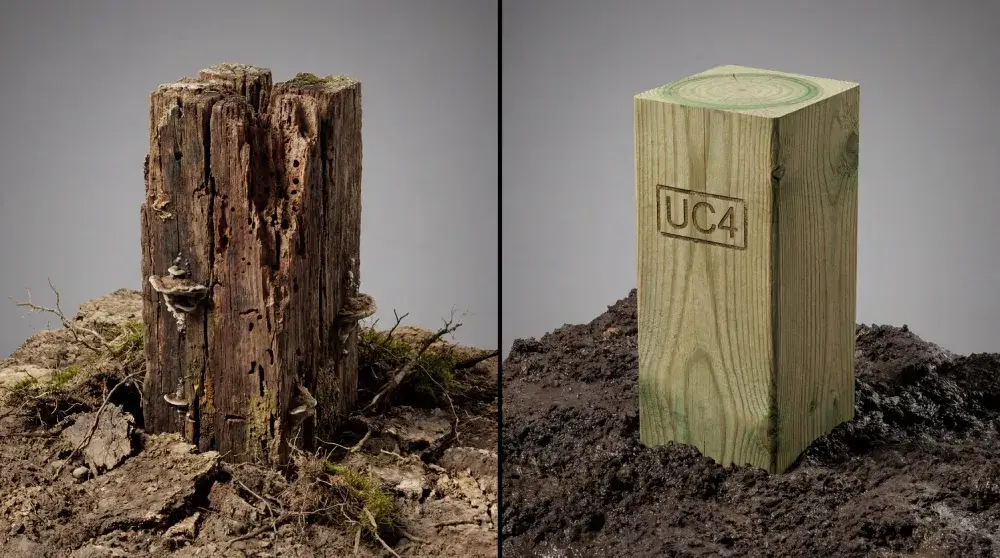
The decision to use treated or untreated timber can mean the difference between a structure lasting decades or failing within years. Preservative-treated timber protects against rot, fungal decay, and insect attack—but treatment adds cost, and not every application requires it.
This guide explains what tanalised and treated timber means, how the UK Timber Use Class System works, when treatment is essential versus optional, and the critical maintenance step that most people miss: protecting cut ends.
What Is Tanalised Timber?
“Tanalised” is a widely recognised brand name for pressure-treated timber, similar to how “Hoover” is used for vacuum cleaners. The term has become synonymous with preservative-treated timber in the UK construction industry.
The Tanalising Process
Tanalising uses vacuum-pressure impregnation to force preservative deep into the timber’s cellular structure:
- Vacuum stage – Air is removed from the wood cells
- Pressure stage – Preservative is forced deep into the timber under high pressure (typically 12-14 bar)
- Final vacuum – Excess preservative is removed, leaving treated wood throughout
- Fixation – Chemical reactions bond the preservative to the wood fibres
This process creates much deeper, more durable protection than surface treatments like brushing or dipping, which only penetrate a few millimetres.
What Preservatives Are Used?
Modern UK timber treatment typically uses:
- Copper-based preservatives – Most common for general construction use (often copper azole or similar)
- Boron-based treatments – Used for interior applications where lower toxicity is preferred
- Organic biocides – Additional fungicides and insecticides in some formulations
Important: Creosote (coal tar) treatment is now heavily restricted in the EU and UK for consumer use due to health concerns. Modern tanalised timber uses safer, water-based preservative systems.
Understanding the UK Use Class System
The Use Class (UC) system categorizes timber treatment levels based on the biological hazard risk in different environments. It’s defined in British and European standards including BS 8417:2011 (Preservation of wood). br />
| Use Class | Environment | Moisture Exposure | Treatment Required |
|---|---|---|---|
| UC1 | Interior, permanently dry | Moisture content stays below 20% | Usually untreated (low risk) |
| UC2 | Interior with occasional moisture | Occasional condensation, but dries out | Light treatment often optional |
| UC3 | Exterior, above ground | Exposed to weather, frequent wetting | Preservative treatment required |
| UC4 | Ground contact or permanent wetness | Soil contact, permanently wet, or fresh water | Heavy-duty treatment required |
| UC5 | Salt water contact | Marine environments | Specialist treatment required |
Use Class Examples in Practice
| Application | Use Class | Treatment Needed? |
|---|---|---|
| Internal studwork in heated building | UC2 | Usually no (well-ventilated, dry) |
| Roof rafters in ventilated loft | UC2 | Usually no (if properly ventilated) |
| External wall framing (timber frame house) | UC3 | Yes – tanalised or equivalent |
| Garden decking subframe | UC3 | Yes – tanalised or equivalent |
| Fence posts in ground | UC4 | Yes – UC4 heavy-duty treatment |
| Ground-bearing sole plates | UC4 | Yes – UC4 heavy-duty treatment |
| Cladding (above ground, well-detailed) | UC3 | Yes – or naturally durable species |
| Conservatory base frame on DPC | UC3 (UC4 safer) | Yes – tanalised recommended |
View our treated regularised timber range →
When Do You Need Treated Carcassing Timber?
Essential Treatment Scenarios
You must use preservative-treated timber for:
- External wall framing in timber-frame buildings (even when clad and protected)
- Any timber in ground contact – fence posts, ground-bearing frames, foundation timbers
- Sole plates on masonry – even with DPC (damp-proof course), treatment adds insurance
- Coastal environments – salt-laden air accelerates decay even on protected timber
- Poorly ventilated spaces – unheated garages, cellars, under-floor voids with inadequate airflow
- Agricultural buildings – exposed framing, animal housing (high moisture, ammonia exposure)
- Garden structures – sheds, decking frames, pergolas, planters, raised beds
Optional Treatment Scenarios
Treatment provides additional protection margin but isn’t always essential for:
- Internal studwork in modern heated buildings with good ventilation
- Roof framing in well-ventilated loft spaces above insulation level
- Floor joists in suspended timber floors with adequate sub-floor ventilation
Risk factors that shift timber from “optional” to “recommended” treatment:
- Older buildings with poorer ventilation
- Bathrooms, kitchens, or wet rooms (elevated moisture risk)
- Coastal locations (within 10 miles of the sea)
- Exposed or sheltered positions (north-facing, tree shade)
- Budget for long-term durability over immediate cost savings
When Untreated Timber Is Acceptable
Untreated regularised timber works well for:
- Internal partition walls in dry, heated buildings
- Ceiling joists above insulation in ventilated roof spaces
- Visible internal framing where treatment staining is undesirable
- Situations where the timber will be replaced or upgraded within 10-15 years
Key principle: Untreated timber is acceptable where moisture content will consistently stay below 20% and the environment is well-ventilated. If in doubt, treated timber provides peace of mind for minimal extra cost.
Critical: Cut-End Treatment (The Step Everyone Forgets)
Here’s the problem: When you cut, notch, or drill preservative-treated timber, you expose untreated wood inside the preservative envelope. This fresh timber is highly vulnerable to moisture ingress and decay—often more vulnerable than if the timber had never been treated at all.
Why Cut Ends Are So Vulnerable
- End grain absorbs moisture 10-15 times faster than face grain
- Pressure treatment penetrates inward from surfaces—the timber core has less preservative
- Cuts expose untreated core directly to weather, soil contact, or moisture
- Capillary action draws water in through the exposed end grain
Result: Rot and decay often start at cut ends, working inward to destroy structural integrity.
How to Protect Cut Ends Properly
The solution: Apply a brush-on end-grain preservative to every freshly cut, drilled, or notched surface.
Step-by-step:
- Cut the timber to length or create notches/holes as required
- Immediately apply end-grain preservative while the cut is fresh (don’t wait days—do it on site)
- Apply liberally to saturation—the wood should appear wet and dark
- Allow to dry before installation (typically 15-30 minutes, check product instructions)
- Reapply to difficult-access areas after installation if needed
Where to apply end-grain preservative:
- Every cross-cut end (even if the cut is only removing a small amount)
- Notches for joist hangers or bird’s mouth cuts in rafters
- Drilled holes for bolts, screws, or services
- Any exposed timber core after planing or chamfering edges
Products to use: Look for proprietary end-grain preservatives from brands like Barrettine, Cuprinol, or Ronseal. These are specifically formulated for rapid penetration into end grain.
Why this matters: Most premature timber failure in treated structures happens at unprotected cut ends. Five minutes with a brush and a tin of preservative can add decades to timber lifespan.
Treated Timber and Fixings: Corrosion Considerations
Preservative-treated timber contains copper and other chemicals that accelerate corrosion of standard steel fixings. Using the wrong fixings with treated timber leads to rust, staining, and structural weakness.
Fixing Specification for Treated Timber
| Timber Treatment | Minimum Fixing Standard | Preferred Option |
|---|---|---|
| Untreated timber (interior) | Standard zinc-plated screws/nails | As required for application |
| Tanalised UC3 timber | Hot-dipped galvanised (HDG) | Stainless steel (A2 or A4 grade) |
| UC4 timber (ground contact) | Hot-dipped galvanised (HDG) | Stainless steel A4 (marine grade) |
| Coastal/marine environments | Stainless steel A4 | Stainless steel A4 (only option) |
Why this matters:
- Standard zinc-plated screws will rust rapidly in treated timber
- Rust staining bleeds through paint and finishes
- Corroded fixings lose strength and can fail structurally
- Galvanised or stainless fixings cost more upfront but last the life of the structure
Joist hangers and brackets: Specify galvanised or stainless steel connectors for treated timber. Standard mild steel brackets will corrode quickly when in contact with preservative chemicals.
Does Treatment Affect Timber Strength or Dimensions?
Strength Grading
Treatment does not change the strength class. C16 timber remains C16 after tanalising, and C24 remains C24. The grade stamp should still be visible after treatment (though it may be less distinct).
Structural calculations and span tables apply to treated timber exactly as they do to untreated timber of the same grade.
Dimensional Changes
Tanalising adds moisture to timber during treatment. After treatment:
- Timber may be slightly swollen initially (typically returns to nominal dimensions as it dries)
- Treated timber can have higher moisture content (18-22%) than kiln-dried untreated timber (14-16%)
- Allow treated timber to acclimatise and dry before precision fitting, especially for joinery
Practical impact: For structural carcassing, this is rarely an issue. For exposed joinery or tight tolerances, factor in a settling period after delivery.
Appearance
Modern copper-based preservatives give treated timber a greenish tinge. This fades over time to a silvery-grey when exposed to UV light and weathering. The green colour is cosmetic and does not indicate treatment quality.
If appearance matters (visible internal framing, feature timber), specify untreated timber where the application allows, or plan to paint/stain treated timber to mask the colour.
How Long Does Treated Timber Last?
Service life depends on Use Class, detailing, and maintenance:
| Application | Expected Service Life | Notes |
|---|---|---|
| UC3 external cladding (protected) | 15-30+ years | Depends on detailing and maintenance |
| UC3 decking frame | 15-25 years | With proper cut-end treatment |
| UC4 fence posts (in ground) | 10-20 years | Highly variable—soil conditions critical |
| UC3 external wall frame (clad) | 60+ years | When properly detailed with cavity/breathable membrane |
Factors that extend service life:
- Good detailing – water runoff, ventilation, avoiding trapped moisture
- Protecting cut ends religiously
- Using correct fixings (no corrosion)
- Regular inspection and maintenance
- Avoiding horizontal surfaces that collect water
Factors that shorten service life:
- Ignoring cut-end treatment
- Poor detailing – water traps, no drip edges, blocked ventilation
- Ground contact with inadequate treatment level
- Using untreated fixings that corrode
FAQ: Treated & Tanalised Timber
What does tanalised timber mean?
Tanalised timber is pressure-treated with preservatives to protect against rot, fungal decay, and insect attack. The tanalising process forces preservative deep into the wood using vacuum-pressure impregnation, providing long-lasting protection in exterior and high-moisture applications.
Can I use untreated timber for external framing?
No. External framing exposed to weather (Use Class 3) requires preservative treatment. Untreated timber will decay rapidly when subjected to repeated wetting, leading to structural failure. Always use UC3-rated tanalised or equivalent treated timber for external applications.
Do I need to treat cut ends on tanalised timber?
Yes—this is essential. When you cut treated timber, you expose untreated wood core that’s highly vulnerable to moisture and decay. Always apply brush-on end-grain preservative to every cut, notch, and drilled hole immediately after cutting. This single step prevents most premature timber failures.
What Use Class do I need for decking?
Decking subframes and joists require Use Class 3 (UC3) treatment as they’re exposed to weather but not in ground contact. Decking boards themselves also benefit from UC3 treatment, though some naturally durable hardwoods (oak, iroko) can be used untreated if properly detailed.
Can I paint or stain tanalised timber?
Yes, but allow the timber to dry first. Freshly treated timber has elevated moisture content and should be left to weather for 4-8 weeks before painting or staining. Use exterior-grade paints or stains designed for treated timber. The greenish preservative colour will show through light stains but is masked by solid paints.
Is treated timber safe for raised vegetable beds?
Modern copper-based treatments (post-2004) are generally considered safe for vegetable gardens, though some gardeners prefer untreated timber or naturally durable species (oak, larch) for food-growing areas. Avoid older creosote-treated timber for edible gardens. If concerned, line beds with plastic membrane to create a barrier.
Does treated timber smell or leach chemicals?
Freshly treated timber has a slight chemical odour that dissipates within weeks. Modern water-based preservatives are low-odour compared to older solvent systems. Chemical leaching is minimal after the preservative has fixed (cured)—typically 2-4 weeks after treatment. Avoid using treated timber where it will be in direct contact with drinking water or animal feed.
Related Guides
- Regularised Timber Sizes: UK Guide to Nominal vs Finished Dimensions – Understanding actual dimensions when ordering treated carcassing
- C16 vs C24 Timber: Which Strength Grade Do You Need? – Structural grading for treated load-bearing timber
- Regularised vs Sawn Carcassing: Which Should You Choose? – Comparing timber finishes for treated applications
- Regularised Timber Category Page – Browse our treated and untreated carcassing timber
Need advice on timber treatment for your project? Contact Ryedale Timber on 07403 011246. We supply tanalised regularised timber in Use Classes UC3 and UC4 across North Yorkshire and East Yorkshire with expert guidance on specifications and applications.