
Regularised Timber Sizes: UK Guide to Nominal vs Finished Dimensions
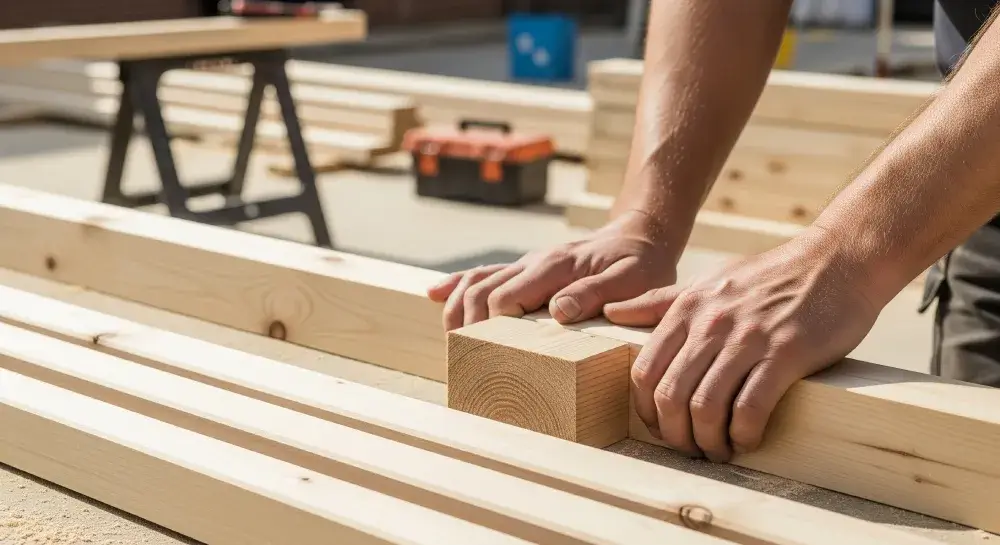
The single biggest source of confusion when buying regularised timber is understanding that the size on the label is not the size you receive. A piece marked as 6×2 (150×47mm) will actually measure closer to 145×45mm. This isn’t a mistake or poor quality—it’s how regularised timber works, and understanding the difference between nominal and finished sizes is essential for accurate project planning.
This guide explains why timber sizes are smaller than stated, provides a complete UK size chart with typical finished dimensions, and shows you how to measure and specify correctly to avoid costly mistakes on site.
Why Regularised Timber Is Smaller Than the Label Says
Regularised timber starts as rough-sawn timber cut to nominal dimensions (the size stated in the product name). It then undergoes a machining process where all four faces are planed to create:
- Consistent cross-sections along the timber’s full length
- Smooth working surfaces that are easier to handle and install
- Eased (rounded) edges that reduce splinter risk during handling
This machining removes material from all four sides. The amount removed depends on:
- Supplier machining tolerances and equipment setup
- Moisture content at the time of machining
- The specific product line (carcassing vs CLS vs PAR)
Typical Size Reductions in UK Regularised Timber
As a general guide, UK suppliers typically machine away:
- Thickness: Approximately 2-3mm from the nominal dimension
- Width: Approximately 4-6mm from the nominal dimension
Important: These are indicative ranges, not guarantees. Actual finished sizes vary between suppliers, batches, and moisture conditions. Always verify the exact finished dimensions in the product specification before ordering.
Complete UK Regularised Timber Size Chart
The table below shows common nominal sizes and their typical finished dimensions. Remember to check your supplier’s specification for exact measurements.
| Nominal Size | Common Name | Typical Finished Size | Common Lengths |
|---|---|---|---|
| 47 × 50mm | 2×2 | ~45 × 45mm | 2.4m, 3.0m, 3.6m |
| 47 × 75mm | 3×2 | ~45 × 70mm | 2.4m, 3.0m, 3.6m, 4.8m |
| 47 × 100mm | 4×2 | ~45 × 95mm | 2.4m, 3.0m, 3.6m, 4.8m, 5.4m |
| 47 × 125mm | 5×2 | ~45 × 120mm | 3.0m, 3.6m, 4.8m, 5.4m |
| 47 × 150mm | 6×2 | ~45 × 145mm | 3.0m, 3.6m, 4.8m, 5.4m, 6.0m |
| 47 × 175mm | 7×2 | ~45 × 170mm | 3.6m, 4.8m, 5.4m, 6.0m |
| 47 × 200mm | 8×2 | ~45 × 195mm | 3.6m, 4.8m, 5.4m, 6.0m |
| 47 × 225mm | 9×2 | ~45 × 220mm | 4.8m, 5.4m, 6.0m |
| 75 × 150mm | 6×3 | ~72 × 145mm | 3.6m, 4.8m, 5.4m, 6.0m |
| 75 × 225mm | 9×3 | ~72 × 220mm | 4.8m, 5.4m, 6.0m |
View our full range of regularised timber →
How to Measure Regularised Timber Correctly
Accurate measurement is essential when matching timber to joist hangers, wall plates, or engineered connectors where tolerances are tight.
For Design and Ordering
- Always work from finished sizes stated in product specifications, never nominal labels
- Build 3-5mm tolerance into door/window openings and panel sizing to accommodate variation
- Never assume nominal = actual when calculating materials—this causes expensive mistakes
- Check multiple pieces from your delivery batch if precision matters (e.g., matching hardware)
On Site Measurement Best Practice
- Measure at mid-length rather than the ends, which can be damaged or uneven from handling
- Use thickness × width convention (e.g., 45mm thick × 95mm wide for a 4×2 piece)
- Check several pieces before setting out critical dimensions like stud centres or joist spacings
- Account for moisture movement—timber continues to shrink slightly as it acclimatises to site conditions
Understanding Moisture Movement and Final Sizing
Even after regularising, timber is not dimensionally stable. Wood is hygroscopic—it absorbs and releases moisture based on the surrounding environment, causing dimensional changes.
Typical Moisture Content Journey
| Stage | Moisture Content | What Happens |
|---|---|---|
| At delivery | 16-20% | Kiln-dried regularised timber typical range |
| Indoor equilibrium | 12-15% | Timber dries further and shrinks 1-2mm in width/thickness |
| Poor storage | 20%+ | Timber absorbs moisture, swells, and risks twisting/cupping |
Practical impact: A 6×2 piece that measures 145×45mm at delivery might shrink to 144×44mm after several weeks in a heated building, or swell to 146×46mm if stored in damp conditions.
This is why proper storage (flat, covered, off the ground, with airflow) and acclimatisation (7-14 days in the installation environment) matter for precision work.
Common Sizing Mistakes and How to Avoid Them
Mistake 1: Designing to Nominal Sizes
The problem: Setting out a stud wall at 100mm centres assuming 4×2 timber is actually 100mm wide.
The solution: Design to 95mm centres based on the finished size. Build tolerances into your drawings.
Mistake 2: Not Checking Supplier Specifications
The problem: Assuming all 6×2 timber finishes at 145×45mm regardless of supplier.
The solution: Always verify exact finished dimensions in the product listing before ordering, especially for engineered connections.
Mistake 3: Ignoring Moisture-Related Shrinkage
The problem: Installing timber immediately after delivery without allowing acclimatisation.
The solution: Where precision matters (fitted joinery, tight panel gaps), let timber acclimatise for 7-14 days in the installation environment.
Mistake 4: Mixing Regularised and Sawn Timber in the Same Frame
The problem: Using regularised studs with sawn timber lintels—different dimensional consistency causes alignment issues.
The solution: Use consistent timber types within a single structural element or frame assembly.
FAQ: Regularised Timber Sizes
What is the actual size of 4×2 regularised timber?
4×2 regularised timber (nominal 47×100mm) typically finishes at approximately 45×95mm, though this varies slightly by supplier and moisture content. Always check the product specification for exact dimensions.
Why is my 6×2 timber only 145mm wide?
The “6×2” name refers to the nominal (sawn) size of 150×47mm. Regularising machines away approximately 5mm from the width and 2mm from the thickness to create consistent, smooth faces with eased edges. This is standard practice, not a defect.
How do I calculate how many studs I need if the sizes are different from the label?
Always calculate using the finished size from your supplier’s specification. For example, if you’re building a 2.4m wide wall with 4×2 studs at 400mm centres, work with the actual 95mm width (not 100mm) when calculating spacing and materials.
Does regularised timber shrink after I install it?
Yes. Timber continues to reach moisture equilibrium with its environment. Expect 1-2mm additional shrinkage in width and thickness as kiln-dried timber (typically 16-20% MC at delivery) dries to indoor equilibrium (12-15% MC). Movement is minimal along the grain (length).
Is CLS the same size as regularised carcassing?
No. CLS (Canadian Lumber Standard) uses different nominal conventions and typically finishes smaller than standard UK 47mm regularised carcassing. For example, CLS “4×2” often finishes at 38×89mm, while regularised 4×2 carcassing finishes at approximately 45×95mm. They are not interchangeable.
Can I trust the sizes in span tables if regularised timber is smaller?
Span tables for structural timber are based on strength class (C16, C24) and the actual cross-sectional dimensions, not nominal sizes. When consulting span tables, use the finished dimensions of your timber. If in doubt, consult your structural engineer or Building Control officer.
Browse our regularised timber range with full specifications →
Related Guides
- C16 vs C24 Timber: Which Strength Grade Do You Need? – Understanding structural grading for load-bearing applications
- Tanalised & Treated Carcassing Timber: Complete Protection Guide – When to specify preservative treatment and Use Class requirements
- Regularised vs Sawn Carcassing: Which Should You Choose? – Cost, finish, and application comparison
- Regularised Timber Category Page – Full product range and quick reference guide
Need help choosing the right timber sizes for your project? Contact Ryedale Timber on 07403 011246. We serve trade, agricultural and DIY customers across North Yorkshire and East Yorkshire with expert advice and competitive delivery rates.