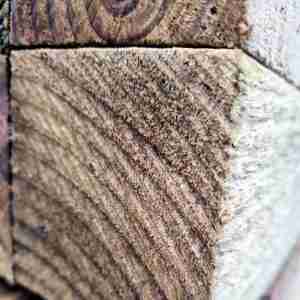
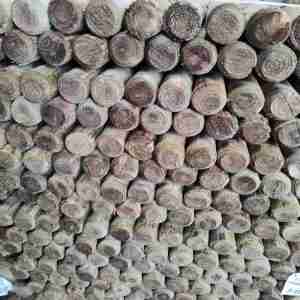
Ryedale Timber supplies professional-grade fence posts to builders and farmers across North Yorkshire & East Yorkshire. To ensure a long service life in ground contact, our timber posts are pressure-treated with Tanalith E. For critical structural applications, we provide UC4 (Use Class 4) treated kiln-dried redwood, specifically engineered to resist rot and fungal attack for up to 15 years.
What are UC4 Fence Posts?
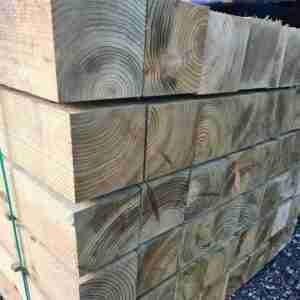
The longevity of a timber post is determined by its “Use Class.” While standard timber is often treated to Use Class 3 (above ground), fence posts require Use Class 4 (UC4) treatment. This involves kiln-drying the timber to a moisture content below 28% before high-pressure treatment, allowing the preservative to penetrate deep into the sapwood.
At Ryedale Timber, we recommend UC4 kiln-dried redwood posts for all permanent installations. Without this specific treatment level, timber posts in contact with damp soil typically fail within 3–5 years.
Key Applications & Use Cases
Our range covers every vertical requirement for fencing and landscaping:
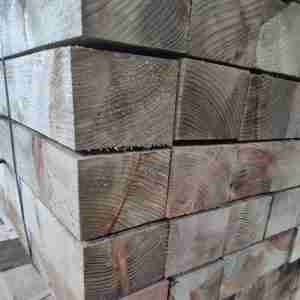
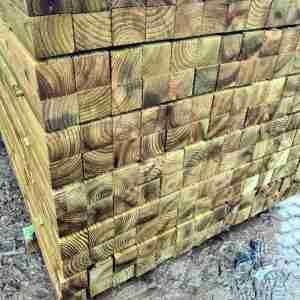
Domestic Fencing: Standard 3×3 and 4×4 intermediate posts for lap panels and closeboard fencing.
Gate Posts: Heavy-duty 6×6 and 8×8 sections designed to support the weight of driveway gates without warping or sagging.
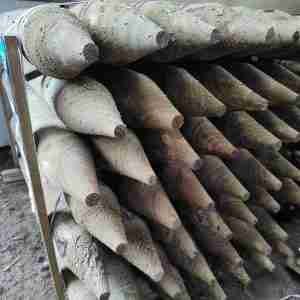
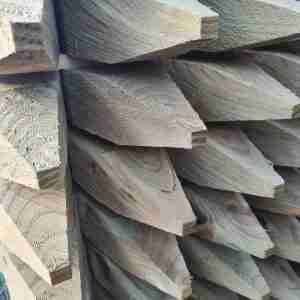
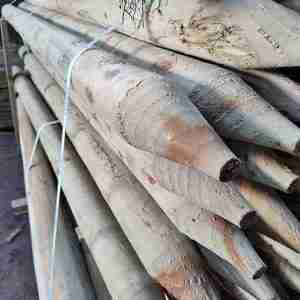
Agricultural Fencing: Machined round posts and cundy (peeled) posts for wire runs, livestock containment, and paddocks.
Strainer Posts: Thick-section round or square posts used at the ends or corners of wire fences to maintain tension.
Performance & Technical Standards
Every fence post we supply is selected for structural integrity and treatment receptivity:
Biological Durability: We prioritise Redwood (Scots Pine) over Spruce (Whitewood) for our square posts, as Redwood absorbs preservative more effectively, meeting BS 8417 standards.
Precision Sizing: We provide both rough-sawn and machined finishes. Note that a “4×4” nominal post may measure slightly less if it has been machined or planed for a smoother finish.
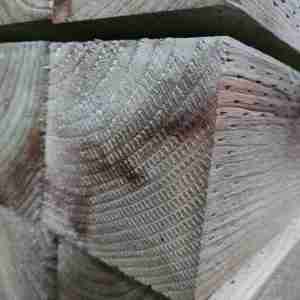
Incising Technology: Our high-specification agricultural posts often feature “incising”—thousands of small mechanical cuts that allow treatment to reach the heartwood.
Choosing the Right Post: Round vs. Square
Selecting the correct profile depends on your fencing type and aesthetic requirements.
| Feature | Square Tanalised Posts | Machined Round Posts |
|---|
| Best For | Panel fencing, closeboard, gates | Post & rail, wire fencing, paddocks |
| Primary Species | Kiln-dried Redwood / Larch | Spruce / Pine / Douglas Fir |
| Treatment Level | UC3 or UC4 available | HC4 / UC4 (Ground Contact) |
| Installation | Set in Postcrete or Bolt-downs | Driven or dug-in |
Professional Warning: Do not use untreated or “dip-treated” timber for ground contact. Only pressure-treated (tanalised) timber with a minimum UC4 rating should be buried or set in concrete to ensure structural safety.
Installation Essentials: Postcrete & Protection
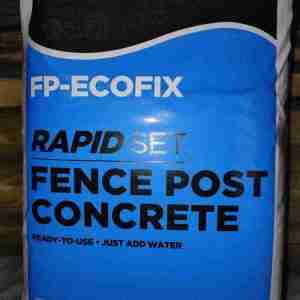
Postcrete (Postfix): For a fast, reliable set, we supply 20kg bags of rapid-setting concrete. Typically, one to two bags are required per post depending on hole depth and diameter.
End-Grain Preserver: If you cut the top of a post to height, you must apply a brush-on end-grain preserver. Cutting the timber breaks the chemical “envelope,” leaving the core vulnerable to water ingress and rot.
Post Caps: Adding a post cap or finial is not just decorative; it protects the end-grain from “checking” (splitting) caused by sun and rain exposure.
Why Trade & DIY Choose Ryedale Timber
Pickering Yard Management: We don’t just “drop ship.” We manage our own yard in Pickering, ensuring posts are stored flat and straight, preventing the “banana” effect common in big-box retail stock.
Honest Grading: We clearly differentiate between standard tanalised posts and premium UC4 redwood. You get exactly the durability you pay for.
Local Knowledge: We understand the heavy clay and limestone soils of North Yorkshire and can advise on the best installation methods for your specific local ground conditions.
Fence Posts: Local Expertise & Quality
Ryedale Timber is the leading supplier of high-quality fence posts in Pickering. We specialise in providing durable, pressure-treated timber to trade and DIY customers across North Yorkshire and East Yorkshire.
Our dedicated delivery fleet provides reliable service to York, Scarborough, Malton, and Thirsk. We also regularly supply agricultural and domestic projects in Driffield, Bridlington, Whitby, and Filey. For rural builds in the Moors or the Wolds, we deliver to Helmsley, Kirkbymoorside, Easingwold, Pocklington, Guisborough, and Robin Hood’s Bay.
Timber Delivery: North Yorkshire & East Yorkshire
We deliver our full range of fence posts, gate posts, and agricultural rounds to the following areas.
| Delivery Area | Postcodes Covered | Flat Rate | Minimum Spend |
|---|
| Pickering | YO18 | £5.00 | £50 |
| Malton | YO17 | £10.00 | £100 |
| Scarborough | YO11, YO12, YO13 | £10.00 | £100 |
| Filey | YO14 | £12.00 | £100 |
| Helmsley | YO62 | £15.00 | £150 |
| Kirkbymoorside | YO62 | £15.00 | £150 |
| Bridlington | YO15, YO16 | £15.00 | £200 |
| Whitby | YO21 | £20.00 | £200 |
| Robin Hood’s Bay | YO22 | £20.00 | £200 |
| Driffield | YO25 | £30.00 | £300 |
| York | YO1, YO10, YO19, YO23, YO24, YO26, YO30, YO31, YO32, YO43, YO44, YO51, YO60 | £30.00 | £300 |
| Easingwold | YO61 | £30.00 | £300 |
| Thirsk | YO7 | £35.00 | £300 |
| Pocklington | YO41, YO42 | £35.00 | £350 |
| Guisborough | TS14 | £40.00 | £500 |
Related Timber Products
Complete your project with our high-quality accessories and fencing components:
Frequently Asked Questions
How deep should a timber fence post be?
The general rule of trade installation is that one-third of the post should be in the ground. For a standard 6ft (1.8m) high fence, you should use an 8ft (2.4m) post, with 2ft (600mm) buried. This depth is essential to resist wind loading and prevent the fence from leaning over time. For high-wind areas or heavy gates, increasing the depth to 3ft is recommended.
Should timber fence posts be set in concrete?
Yes, for domestic panel fencing, setting posts in concrete (using a rapid-set Postcrete) provides the most stable foundation. However, it is vital to avoid “encasing” the very bottom of the post in a concrete cup, which can trap water against the timber. Ensure the concrete starts a few inches above the base of the post, allowing water to drain away into the soil or hardcore below.
What are common fencing mistakes?
The most frequent mistake is using below-ground timber that is not UC4 rated. Many retailers sell dip-treated or standard tanalised timber for posts which will rot at the ground line within a few years. Other common errors include not using end-grain preserver on cut tops, setting posts too shallow, and failing to use a gravel board to keep the main fence panels off the damp earth.
How to keep wood posts from rotting in the ground?
To maximise lifespan, always specify UC4 kiln-dried redwood posts. Additionally, ensure the post hole has a layer of gravel or hardcore at the bottom for drainage; this prevents the post from “sitting in a puddle” inside its concrete sleeve. For ultimate protection, consider using bitumen “post saver” sleeves at the ground line, where the combination of oxygen, moisture, and fungi is most aggressive.
What is the average lifespan of a fence?
A fence constructed with standard materials typically lasts 5–8 years. However, a fence built using Ryedale Timber UC4 treated posts and tanalised components, installed with proper drainage and gravel boards, can easily last 15 to 20 years. Regular maintenance, such as clearing debris from the base of the fence and checking post caps, will further extend this lifespan.